Designer skills
After completing my master’s, I am reflecting on what I have learned
by framing these outcomes in different areas of expertise.
Technology and Realization
Technology is central to my design process. It is crucial to deeply
understand technology and its opportunities and limitations. It is a
core element in defining the problem and design space, not only a
solution. My final master project demonstrated this deep
understanding as I present a solution that is innovative but also
technologically achievable in the current market.
Additionally, I can quickly create interactive functional prototypes
with high demonstrative value. These porotypes help me gather
meaningful insights. During and after my final master project I
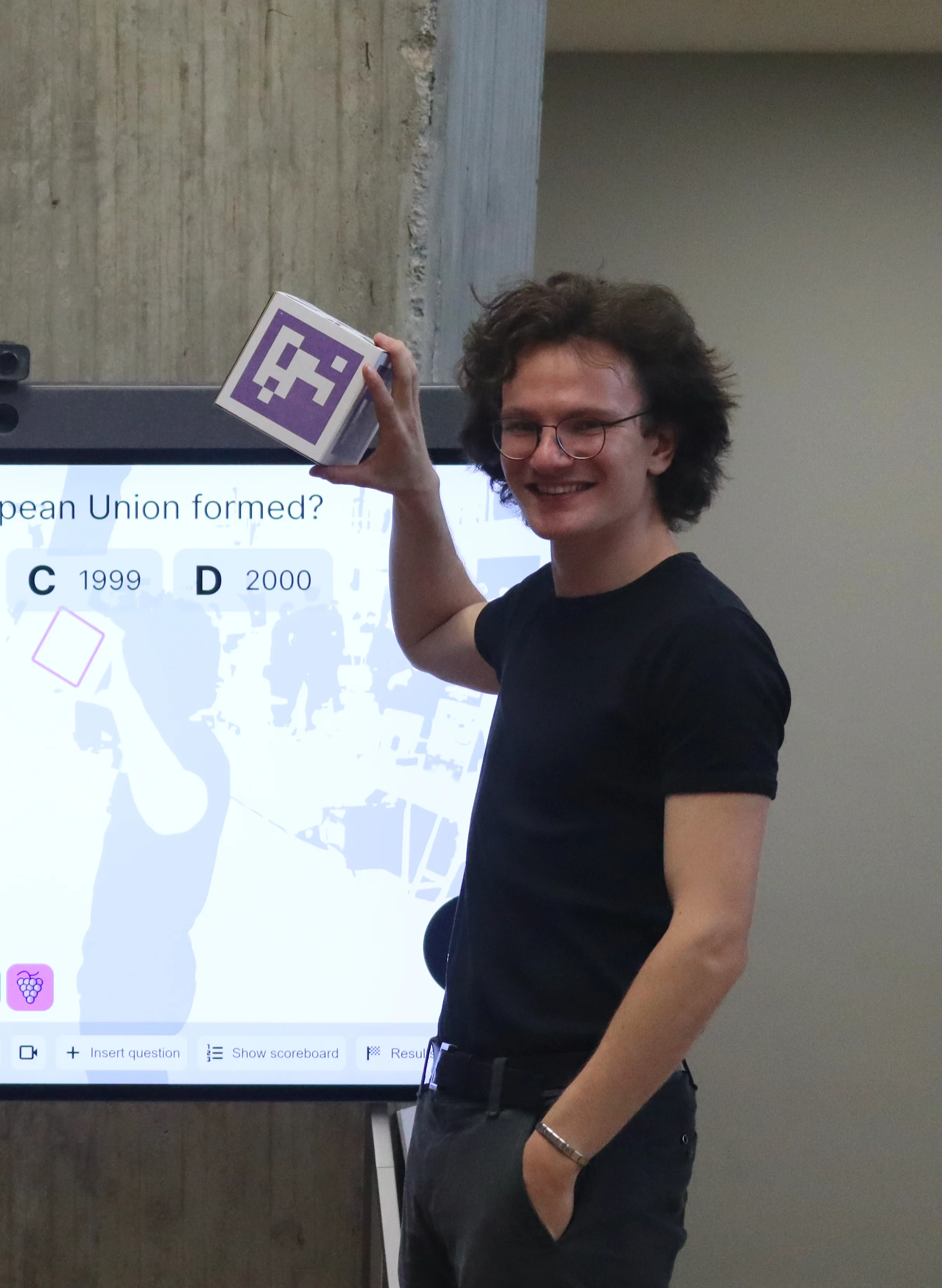
created Qwiz, which was used
to successfully tested in a real world classroom. Additionally, I
put my final bachelor project Corpus into the Philips museum, where it can be currently used.
Finally, as a designer focused on creating novel and
non-standard interfaces, I often need to leverage my math, data,
and computing skillset to realize unique high-level interfaces. For example, I optimized Qwiz marker detection to smoothly run in the web and created proper data flows. Moreover, I automated the marker cube blueprint generating process through automating this task with a Python script.
User & Society
When designing new interfaces for existing systems,
understanding why and how these systems are currently used
is important. I achieve user understanding both through
literature/theory and research in real life. During my final
master project, I involved real users throughout the entire
design process by conducting interviews, observations and tests in the classroom. My strength lies in executing these activities
quickly while still achieving highly relevant results.
When it comes to the usability of my designs, I learned that
the most important part of usability is explaining what the
design is meant to do. Once users understand the purpose,
they tend to figure out the functionality themselves. While
preparing Corpus for the Philips Museum, I realized visitors
struggled with the interface because they did not understand
its goal. Once this was addressed, the design became a
valuable part of the exhibition.
Business & Entrepreneurship
A designer must understand market viability and how a design
reaches users. I learned which interfaces and technologies
make products (un)successful and why through market
research. In my SCIO project, I collaborated with CTOUCH to understand how industry products reach the user. Furthermore,
I consulted with various industry experts from Studio Tast, LessonUp and Gynzy, to find out what it would take for my design to be
integrated in industry products.
Creativity & Aesthetics
I use creativity as a guiding force throughout the design
process iteratively by ideating, prototyping and evaluating
multiple designs in an exploratory way. Additionally I use
it as a focused step developing solutions that interpolate
between user, industry and technology, and puzzling together
a solution that satisfies all three. For Qwiz, I combined
possible inputs from the marker cubes with common
educational information structures to find relevant formats. Similarly, I developed marker cubes that were affordable, sustainable, functional, and aesthetic,
showcasing creative solutions.
Design education
Bachelor
During the bachelor Industrial Design at TU/e I developed my
interest for using different interface technologies to
completely change how and by whom a system is used. My My Final Bachelor Project, where I used hand tracking to make artist posing tools
accessible to non-professional users, especially helped shape
this idea. Although I had not concretized this idea to the
current level, I decided to continue the Industrial Design
master at TU/e as well with the goal of further exploring this
direction.
Master
For my first master project Augmented Adventures, our team’s aim was to find the true value of Augmented
Reality for tabletop games. We iteratively ideated,
prototyped and evaluated many designs, gathering insights,
to make our final design, Augmented Adventures. The unique
element of this process was the ideation and realization of
multiple designs in each cycle to evaluate and gain insights
by comparing them. Publishing the outcomes of this project
as a conference paper at ICEC 2023 was evidence for me of
the effectiveness of this approach.
For my second master project Social Essence, I redesigned remote collaboration using hand tracking.
Rather than making the system accessible to a new user group
like in my FBP, I added a new interface to an existing
system to improve social presence for the existing user.
Aiming to repeat and refine the M11 methodology in a
different context, I again iteratively ideated, prototyped
and evaluated multiple designs in an explorative fashion.
Because this project had the goal to generate a research
output rather than a design, I combined the different
technology, user and industry insights into a list of
‘design factors’.
During my third master project SCIO, I redesigned primary school classroom quizzing without
the need for personal devices by using motion tracking, RFID
and visual marker detection. I stated the goal to design for
the current market. To achieve this, I used a triangulation
methodology to combine user, industry and technology
insights to create a comprehensive understanding of the
design space through a set of design principles.
Finally, during my master graduation project Qwiz I continued with my M21 project. I Identified the gap in user
understanding in my previous design triangulation. To tackle
this, I decided to redefine the design problem from a user perspective
through a user centred design approach. This allowed me to better
understand how the current quizzing system was used and formulate
my final design.